Thursday, July 19, 2007


A view of the Tulsa Rose Garden in Midtown Tulsa

COMING THIS FALL: NEW TULSA STREET STORIES

More Tulsa Street Stories will be coming soon to a computer near you. Starting in September 2007, TU News Gathering students will be writing a new batch of stories to the Tulsa Street Stories site.

Check this site later for stories, photos and more from Prof. John Coward's TU class site. Thanks for your interest in Tulsa Street Stories.

Monday, November 27, 2006


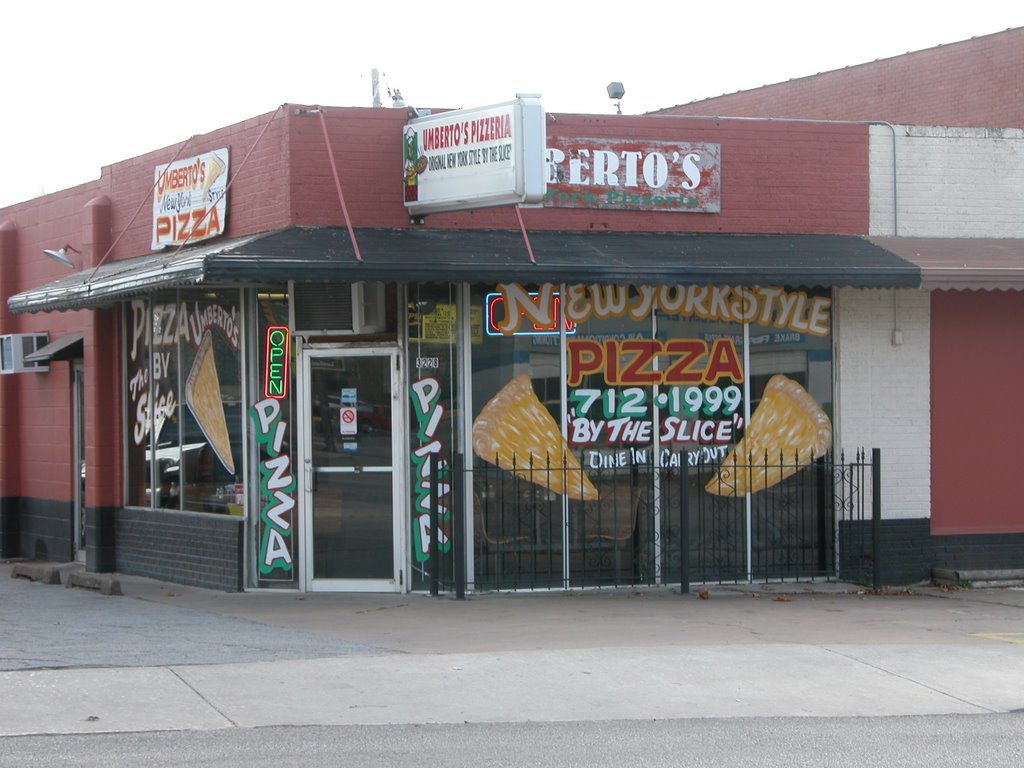
FINDING COMMUNITY AT UMBERTO'S PIZZA

I am not from Tulsa.

I need to say that because it conditions my response to this assignment. I am from St. Louis, where there are over 50 neighborhoods and I have a vague idea where about half of them are.

But drop me in T-Town and tell me to find a neighborhood, and I will stare at you wide-eyed and terrified. So when I found out I had to write about a local community, I went to a friend of mine who was raised here.

He told me to go to Umberto’s Pizzeria, on 21st Street just west of Harvard. He promised that I would find a full cast of interesting characters.

I initially found this statement to be flagrantly false. My friends and I were the only people in the restaurant.

So there I was, alone in a pizzeria and in serious need of some sort of community environment. After just a few minutes, though, it became obvious that there is a strong community in Umberto’s. But it isn’t in the restaurant proper—it’s in the large, open kitchen.

The workers of Umberto’s are a neighborhood unto themselves. While I was there, they were speaking Spanish to each other, their cheerful dialogue punctuated with bursts of uproarious laughter.

When Juan, the manager, tells me his favorite part of his job, he pitches his voice to be heard by the rest of the employees and says, “Telling them what to do.”

The other workers all laugh and call out flippant responses, and Juan laughs as though he had orchestrated the whole exchange. There’s something very familial in the way they all seem to know exactly what to say to get a rise out of the others, and the way they grin a little when they’ve finished saying something they know will get a laugh.

Umberto’s Pizzeria is not exactly what I was looking for when I set out to write this story. I was thinking more along the lines of a “where everybody knows your name” place.

But, really, a neighborhood feeling has nothing to do with how crowded a place is. It comes from the interactions of the people, the “cast of characters,” as my friend would say. And Umberto’s has characters that are truly worthy of applause.

--Laura Hermann

Friday, November 24, 2006


LIFE ON TULSA'S INDIANAPOLIS STREET

As I stepped out of my car and into a big pile of yellow and orange leaves, two kids greeted me.

“Would you like to buy some beef jerky, or a candy bar?” one of them asked.

I didn't.

After my visit with the kids, I began my walk down the long sidewalk. Indianapolis Street is located near Harvard and Eleventh Street. I picked this quiet neighborhood because it looked so diverse and interesting.

I drew in a deep breath of the crisp cold air; it smelled of fall leaves and acorns. The homes along Indianapolis Street are small and meticulous, some nicer than others.

One house in particular stood out to me. The house, which sits inside an iron fence, is a dark, algae-green color and decorated with numerous yard decorations. Two large trees and several bird feeders sit in the yard.

The four steps leading from the sidewalk onto the property guide you to patchy grass. The house has six big windows, in where I saw a gray cat sitting on the inside window ledge.

Directly across from the "algae" house is a white house with a burgundy cement porch. Four college boys live there. Luckily, one was stepping out of his car while I was around.

“How long have you lived in this house?” I asked him. The tall young man with curly blond hair replied, “About three months. We all moved in at the beginning of the semester.”

I asked him why they chose to live here. “It’s less that five minutes from campus which is nice, and this was one of the few four bedroom homes we could find,” he explained.

I thanked him and continued to walk down the street. As I came to the end of the sidewalk, I noticed a couple homes had decorative lights complimenting the trees and various aspects of the houses.

This end of the neighborhood was more chic and “homey.” The two kids I met earlier lived here. They were playing in the yard on their bicycles.

“We like our neighborhood because there’s lots of kids to play with,” the little girl said. She hopped back on her bicycle and peddled up to the other end of the neighborhood, the boy following closely behind.

--Lindsey Naylor

Wednesday, November 22, 2006

FIRST LUTHERAN SERVES MIDTOWN TULSA

The babble of children’s voices fills the parking lot play area of First Lutheran Church, 1244 South Utica Ave. It’s not Sunday, but ministry is a daily occurrence here.

Across the street, a sign in front of one building reads “Luther Place on Troost: A Senior Living Center with Assistance.” This refurbished apartment building is one of the many ministries of this church, located near Hillcrest Hospital.

Sharolyn is at the information desk as I enter. She had to “buzz” me in. Monitoring who comes and goes is all part of the service and the security associated with providing services for the very young and senior citizens.

“My job is to take messages, answer questions about various programs, monitor who comes and goes, and take Angel Food orders. I’m also in charge of Trinity Ministries. We have a Senior Nutrition Site here, a Senior Exercise Group, Senior Computer Classes, all kinds of programs,” Sharolyn said.

While I have been talking with her several other people have come and gone and the smell of lunch is in the air.

Melissa Shell is the First Lutheran Early Learning Center director. “The ELC has been in existence off and on for quite some time. One lady said her grandchildren came here 30 years ago,” she said.

“We’re currently a two-star facility and have four staff members who have their Child Development Associate certification and two more with Mastery certification. The rest are in school to obtain either an associate’s degree or their CDA,” Shell said.

“We’re here to serve our community, we service children who are blind, have kidney problems, and motor skill disabilities,” Shell said.

“Our classrooms build on each other. The infants get a lot of love and care. There’s a monthly curriculum for development that includes stories and songs, and by the time the children are in the Pre-K classes there are writing centers and they are learning colors and shapes,” she said.

The Early Learning Center is licensed to serve 52 infant through Pre-Kindergarten children and currently has 43 enrolled. The facility hopes to be fully accredited by next year.

Shell had to dash. She was headed to the store to buy milk for break time in the ELC.

First Lutheran also has programs that provide sack lunches for the homeless, a meeting place for Alcoholics Anonymous, and a meeting place for a Senior Deaf Group.

The ministry will hold a Jazz Festival Fundraiser on Thursday, Jan. 25, 2007.

--Karen Groff

Monday, November 20, 2006


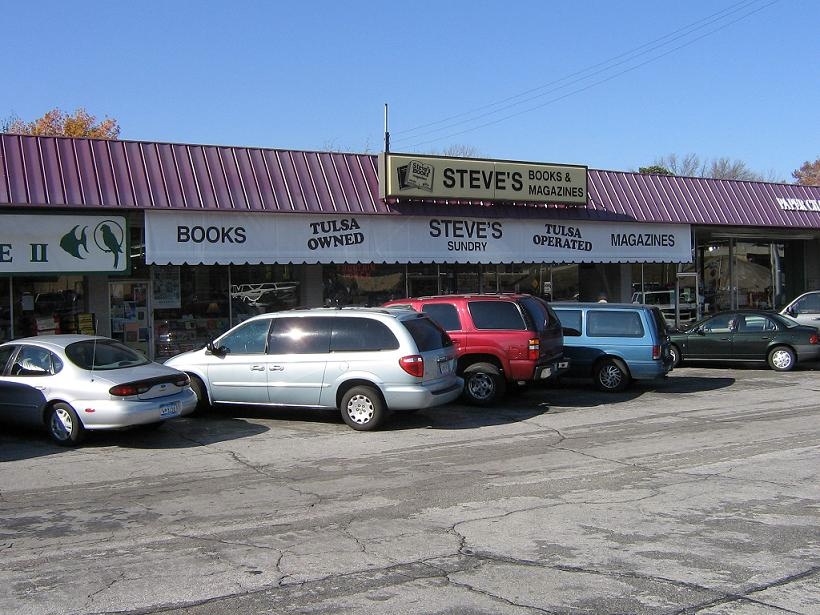
STEVE'S SUNDRIES: THE CHARMS OF THE NEIGHBORHOOD SHOP

Steve’s Books and Magazines—also known as Steve's Sundries—is nestled in the middle of a shopping center right where the Broken Arrow Expressway crosses over Harvard. It's the type of place that’s going out of style.

Corporate chains like Barnes & Noble—spacious, bright, and predictable—have taken a big place in our consumer consciousness. But there's a certain comforting charm in this little neighborhood shop that I’ve never found in a sterile chain store.

Under the same ownership for 59 years, Steve’s offers what seems like every magazine imaginable, along with paperbacks, candy, puzzles, posters, and other knickknacks. Cramped aisles are packed with goodies, the merchandise seeming to spill out, overwhelming the senses.

During my first visit, the air smelled heavily of dill pickles.

A soda fountain in the back, serving sandwiches, breakfast, sodas and shakes, attracts young and old alike, and allows for Steve’s catch phrase: “Whether you’re looking for shakes or Shakespeare, Steve’s is your place!”

I met the owner, Steve, by chance on my first trip, and he was more than eager to talk, shuffling to a corner to set down his cup of coffee and have a chat. He was quite proud of the fact that his store was the first of its kind to sell both books and magazines under the same roof.

Surprisingly, his relationship with bigger stores like Barnes & Noble is amicable, and he feels like more of a teacher than anything.

“I used to joke that we taught Barnes & Noble how to run a store,” he said with a chuckle.

Steve’s daughter-in-law, Joanie, currently owns half the store, and attributes its good business to regular customers.

“We have a very, very loyal clientele,” she remarked, telling me about the many women who come in daily to see what’s new. “It’s like Cheers without alcohol.”

Steve’s isn’t strong on designer atmosphere, but it has an old-fashioned feel that makes you feel good about supporting a local business. As long as they keep carrying The Onion, they can certainly count on my return.

--Caroline Richardson

Monday, November 13, 2006

CRIME AND PUNISHMENT IN OKLAHOMA

Burglary and larceny are two major kinds of crime in Oklahoma and the state's second largest city, Tulsa, has a higher crime rate on average than the state's largest city, Oklahoma City.

These are among the crime figures published by the information website areaconnect.com.

Statewide, 35,692 burglaries were reported in 2005, along with 93,814 larcenies. Oklahoma recorded 187 murders in 2005, down from 206 the previous year.

The most recent data comparing the crime rates of Tulsa and Oklahoma City were published in 2004 by disaster.com. The murder rate in Tulsa was 12.3 per 100,000 population, nearly double Oklahoma City's rate of 7.4 per 100,000. Aggravated assault was also significantly higher in Tulsa, 850 per 100,000 population compared to Oklahoma City's 521 per 100,000.

As of October 2006, Oklahoma prisons held almost 25,000 offenders, according to the Oklahoma Department of Corrections. The gender breakdown reported by the department this year was 89.7 percent male, 10.3 percent female.

The racial makeup of the prison population was 56.5 percent white, 28.8 percent African American, 8.6 percent Native American and 5.7 percent Hispanic. About 40 percent of those incarcerated were violent offenders, according to the Corrections Department.

Currently, the state has 86 prisoners on death row, including one female. As of mid-November this year, Oklahoma has put four prisoners to death by lethal injection, according to deathpenaltyinfo.org.

--Caroline Richardson
TOP CAUSES OF DEATH IN OKLAHOMA

Oklahoma has seen a significant rise in the number of heart disease related deaths in the past 10 years, according to statistics complied by the Centers for Disease Contol and Prevention.

The figures show that the mortality rate for heart disease varies significantly across the United States, with the highest rates in the southeastern states. Oklahoma's 1999 age-adjusted death rate was 317.4 deaths per 100,000 people, which was significantly higher than the overall U.S. rate of 268. This means that Oklahoma was ranked seventh among the states in heart disease deaths in 1999.

Other top causes of death in Oklahoma were (2) cancer (in the form of malignant tumors), (3) stoke, (4) respiratory diseases, and (5) accidental deaths. The top ten causes of death in Oklahoma also includes (6) influenza and pneumonia, (7) diabetes, (8) Azheimer's Disease, (9) suicide, and (10) atherosclerious.

Oklahoma spent $357.8 billion, or 31.5 percent of the state budget, on health care in 2003, accoring to the State Health Expenditure Report for 2000-2003.

--Brian Fagan

Friday, November 10, 2006

IT'S ALL ABOUT THE MONEY: SOME OKLAHOMA INCOME FIGURES

At $45,000, Tulsa has the highest median salary of any city in Oklahoma, according to PayScale, a research website that tracks such numbers.

Oklahoma City ranks second on the PayScale list, with a median salary of $43,000.

Two Oklahoma college towns are third and fourth on the list, with Stillwater's median income at $40,000 and Norman's at $38,500.

Other Oklahoma cities on the list are Edmond and Lawton, both with a median income of $38,000, and Enid, which showed a median income of $32,280.

Missouri's two largest cities, St. Louis and Kansas City, exceeded Tulsa and Oklahoma City in median salary. Both St. Louis and Kansas City have median salaries ar $48,000.

Additional salary information can be found at the PayScale website, www.payscale.com.

--Lindsey Naylor

Friday, November 03, 2006

MORE STREET STORIES ON THE WAY

The Street Stories experiment is continuing, and new stories will be posted in the coming weeks. Although the fall semester is rapidly winding down, the students have written a new batch of stories for the site.

The first group of new stories will be a bit different because I asked the class to develop stories based on numbers. Using on-line databases and other statistics, I wanted the students to profile Tulsa and Oklahoma numerically. My idea was to get the students more involved in descriptive quantitative data and to process and explain that data in interesting ways.

The students found the assignment harder than they (and I) expected—they were very clear on that point. Nevertheless, they found some curious figures that do tell us more about crime, income, education, industry, agriculture, health and other aspects of the city of Tulsa and the state of Oklahoma.

Look for these postings soon.

--John Coward, Faculty of Communication

Tuesday, October 31, 2006

THE SOUNDS OF BEAU ROBERTSON

He sits propped on a wooden stool with nothing in his hands but a worn guitar. The instrument shows its scars from countless hours of strumming.

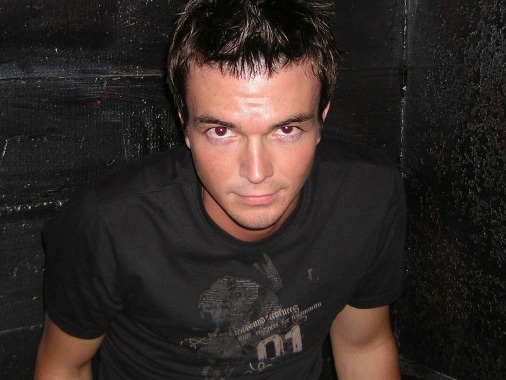
Standing 5 feet 6 inches, Beau's eyes look down at his guitar through a mound of dark, shaggy hair as he starts to pick at his six string. The chords begin to pick up speed and his head slowly rises to meet the microphone in front of him. When he sings, you are taken aback by the soulful undertone you might not expect. He cracks a smile and several of the bar patrons receive him with returning grins.

This is Beau Robertson on a typical Tuesday night at McNellie’s Irish Pub in downtown Tulsa. Robertson, 23, is a Tulsa musician who lives to play music.

“I bartend so I can play music,” he says. You can find Beau at Arnie’s bar once a month and at McNellie’s every Tuesday doing what he loves most: playing music.

People might classify him as a struggling musician, poking around the local bar scene trying to find a gig.

But Beau’s not struggling at all. He’s not trying to pull a record deal or waiting for something better to come his way. As long as he has his guitar in his hand and a microphone at his mouth, he has no complaints.

“I’ve played for two people and I’ve played for 200 people. It makes no difference to me,” he says.

Growing up in Broken Arrow, Beau was drawn to playing music at the age of 13, where he would listen to Tulsa’s own J.J. Cale for hours, mesmerized by his steady voice and smooth guitar. Beau has come a long way since those days.

He's become a weekly favorite in the local bar scene. Simply known as Beau on stage, his music can be heard filtering through the pubs of downtown Tulsa, soothing his listeners, adding to the sounds of the bar.

--Brian Fagan

Sunday, October 22, 2006


A NICE GUY WITH A LITTLE SECRET

Mike is a nice guy with a soft, laid-back demeanor. He is one of those people who you can meet and instantly get along with. Nothing about his presence or personality that would give away his secret, a hobby that is illegal most everywhere.

The 23-year-old student knows a lot of people and is liked by almost all of them. But not many people know that he is a drug dealer. He says that he has recently begun selling small amounts of marijuana.

‘Mike’, who for obvious reasons would like to remain anonymous, doesn’t base his life around the illegal substance. He has a rather indifferent attitude about the drug.

“I really just started doing it so I could have money for beer,” he said, explaining how he got into the ‘business. “I’m basically just being a middle man for my friends.”

Mike says that what he does is a necessary thing for his core group of friends. He and his buddies would buy the stuff anyway, and he says that he just makes the process more convenient.

He does admit, however, that he is taking a big risk, although he seemed confident that he was being smart and safe about the illegal operation.

“I just remember seeing [another dealer] and how open and obvious he was about it,” he said. “I never sell to anyone I don’t know personally, and it’s never very much.”

I met Mike, like many others before me, through a friend of a friend. He seemed intelligent and interesting, and until it somehow came up in conversation, no one knew about his secret ‘hobby.’

It made me wonder about the people I meet in every day and what kind of hidden secrets everyone has.

--Tyler Hearn
DAN CROSSLAND: MAKING MUSIC IN TULSA

It's hard for a solo artist to make a name on the local music scene. It takes talent, a crowd-grabbing personality, and a friendly bar owner who will take the risk of letting an unknown artist play.

Dan Crossland has all of these: a great voice as well as strong guitar and keyboarding skills. He also found a bar owner willing to take a chance.

Crossland used to play every Saturday night at the BruHouse on Brookside, a small, smoke-free, nondescript bar where the stage is really not a stage but just some tables and chairs moved out of the way.

Now Crossland has a busy schedule. With his guitar strapped over his shoulder, microphone in front of his smiling lips, he is ready to take on the music world.

Crossland can play covers from Maroon 5 and John Mayer and make them sound like his own. He plays his guitar like it was attached to him at birth. His voice can lull you to sleep, or it can pump you up and make you want to dance.

“I try and throw in one of my own songs," he said. "I never get much response from it though. People like to sing along, and if they don’t know the words, they usually won’t like the song.”

A few months ago he wrote a song called “Not Going Home."

“It was about a situation in my life where I was telling myself I wasn’t going back, and things were going to be better because of it,” he explained.

It's true that the worst breakups make some of the best songs.

Crossland cracks jokes about the bar and about himself to get people to pay attention to him. “It’s hard to get drunk people to stop talking about themselves and listen to me," Crossland said. "I mean who wouldn’t want to listen to my studly self?”

--Melissa Fulton

Friday, October 20, 2006


THE RIDER WITH THE DREADS

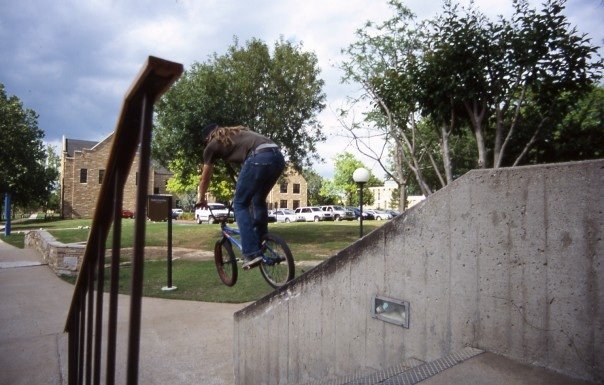
Riding is his passion and dreads are his style. He is Russell Waldin, 24, of Tulsa. With flare in his style and attitude in his hair, Russell was walking into the Business Administration Hall on TU’s campus when I stopped him.

Russell looked entirely different than any other person I saw on campus. His bright orange, tightly fitted T-shirt and his Volcom jeans made him stand out. I asked him if I could ask him a couple questions for my news gathering class and, with a slight bit of hesitance, he said, “Sure, why not?”

“First off,” I asked, “how long have you been growing out your dreads?”

“Oh, for a couple years,' he said, while picking out one of his long, messy dreads. "They’re alright I guess.”

When he’s not working or attending classes in the art school, he rides. Riding is a hobby Russell takes great pride in. He has a sponsor, and has the priviledge of riding in competitions and traveling around United States.

“I’ve been riding forever," he said. "It’s just a lot of fun. It’s something I’m good at, and it’s an escape from reality.”

Feeding on my fascination with his hair, I asked more questions about his dreads: “Do you have dread locks to stand out from the rest of the riders, or did you just want them?”

“I’ve always liked the look of dread locks, but it’s nice because I get recognized because of my hair. It’s definitely my signature! It’s crazy. People I don’t even know, know me.”

Despite this recognition, Russell told me that he was thinking about cutting his hair off.

“My hair is getting heavy. I’d like to be able to put a shirt on with out hassle and it’d be pretty sweet to wear hats again.”

--Lindsey Naylor
AN ART STUDENT'S LIFE

On a recent Tuesday, I stumbled upon an art student drawing in front of Philips Hall. Her artwork was impressive. I stood and gazed as she drew.

The student was Sarah Smith, a TU senior, and a graphic design major from Oklahoma City.

I asked Smith about herself. I learned that she grew up wanting to work in the arts. Even when she was young, she liked drawing and laying out her room just perfectly.

“I was always involved with art club and events that involved graphics in high school,” Smith said.

Having art as a hobby, she never thought that she could do it as a career. But as a TU freshman, Smith decided to make her hobby into a major and study graphic design.

Besides art classes, Smith is social chair of her sorority, where she gets to design and layout events on a regular basis.

“I am planning semi-formal right now, which is a very big undertaking,” Smith said. “I’m using my graphic design methods and making really awesome designs from T-shirts to even the layout of the dance room itself.”

--Emily Pickens

Thursday, October 19, 2006


A NEWBIE IN T-TOWN
A lot of people in Oklahoma have lived in the same town or city for years. This doesn't mean that here people don’t migrate or move, but many people do "stay where they were planted."

Darlene Conn spent most of her life in a small town in eastern Oklahoma. In August, Darlene moved to Tulsa to become the house mom for the Kappa Delta house. For Darlene, the move to Tulsa seemed like a good change in her life.

“I had just left my job at a hospital and I though ‘why not?’," she said.

Darlene is a well-loved person in the Kappa Delta house. Not only does she look out for the girls but, as the house cook, she also provides sustenance. She is a confidant for many of the girls and uses the kitchen as a social gathering place.

In her first few months as the house mom, Darlene doesn’t doubt her decision to move to T-town.

“I am way more proactive in the girl’s lives that I thought I would be. This has definitely been a great experience in my life,” Darlene said.

Darleen is very enthusiastic about Tulsa. “I’m from a small town, so this big-city feel is fantastic. There is so much to do and see and it seems like I learn something new about Tulsa and the state every day,” she said.

After cooking for the girls during the week and on the weekends, Darlene takes time to see the city. Recently she explored the Philbrook Museum. She also attended the state fair and got a look at the giant Tulsa Driller.

Besides being a house mom and cook, Darlene also considers herself part-time adventurer.

“There is no much to see and do in this town and I plan to do it all,” Darlene said. She also uses her time to bond with the members of the house. With ice cream trips and movie nights at AMC, she is taking advantage of the new activities with her many new friends.

--Brandi Andrews