Doing Laundry Means Having Fun at University Wash
By Bridgette Gonzales
Let's face it: a college student’s priority isn’t cleanliness. That being the case, we often end up with a load of laundry that will take hours to take care of in a single load machine.
Taking our dirty clothes to a Laundromat sounds so tedious and boring. Who wants to sit and wait hours while your clothes are in the wash? I don’t.
I would rather be out somewhere having fun or attempting to be productive. But what if there was a way to take care of laundry and take care of something most of us find as a priority: Having fun.
There is.
University Wash Laundromat on 15th St. isn’t your typical laundromat. They have pool tables and video games to help pass the time. More to the point, it's a place where you can have a beer. I’m not encouraging alcoholism, but enjoying a nice cold beer is almost always nice. And University Wash gives you this option with their beer-only bar.
At University Wash, you’ll find a few TU students doing laundry, having a beer, and enjoying time with their friends. It’s a great way to socialize and be productive.
The people are friendly. It's close to campus. It’s fun. And most of all one can truly be productive so long as they don’t forgot to turn on the wash or place the clothes in the dryer as I did. Also, the pool table can be quite the distraction.
University Wash Laundromat, 3132 E. 15th St., is the perfect place for a student to have fun with friends and get clean at the same time.
Wednesday, September 19, 2007


Tulsa Scenes: Kilkinney's Offers Irish Charm
By Emily Gibson
Location
Since I came to the University of Tulsa from out of state, I have had to discover the local hot spots for myself. One of my favorites is Kilkenny’s Irish Pub on 15th St just east of Peoria. The moment I step into the pub, I am transported “across the pond” to Ireland. The music overwhelms me, I have to stop myself from doing a little jig for fear I’d embarrass myself.
All of the decor is straight from Ireland, even down to the signs on the bathroom doors which read Lasses and Lads.
Drinks
Kilkenny’s serves 16 types of beer, ranging from your typical Guinness to specialty wheat ales. They also have an abundance of Irish whiskey and scotch. Like most pubs in Ireland, Kilkenny’s offers more than just beer. They have a full lunch and dinner menu, and offer brunch on the weekends.
Food
The food is moderately priced for the average person, although for the typical college student it is a bit on the pricey side. It is perfect for a date night, birthday, or “I just got paid today, let’s go out” meal. I have to recommend the Chatsworth Boxy, and the Ballybunion Beef Tenderloin Kebabs, which is my personal favorite.
Dessert
The dessert menu is top notch. My mouth waters in anticipation for their well known Irish Balloons; fried pastry balls dusted with powdered sugar and served with sweet Irish whiskey butter sauce.
Irish hospitality
I always leave Kilkenny’s in a better mood than when I arrived. Maybe it has something to do with the wonderful service I received, or my full tummy. I don’t think that’s it though. Kilkenny’s is the type of place where you can leave all of your worries behind and enjoy in the magic that is the true Irish pub.
Linguistic Sidebar
• Boxy: A traditional Irish dish common to rural Ireland consisting of a grilled potato pancake stuffed with different fillings
Link
• You can find the menu, directions to, and more information by clicking here.
By Emily Gibson
Location
Since I came to the University of Tulsa from out of state, I have had to discover the local hot spots for myself. One of my favorites is Kilkenny’s Irish Pub on 15th St just east of Peoria. The moment I step into the pub, I am transported “across the pond” to Ireland. The music overwhelms me, I have to stop myself from doing a little jig for fear I’d embarrass myself.
All of the decor is straight from Ireland, even down to the signs on the bathroom doors which read Lasses and Lads.
Drinks
Kilkenny’s serves 16 types of beer, ranging from your typical Guinness to specialty wheat ales. They also have an abundance of Irish whiskey and scotch. Like most pubs in Ireland, Kilkenny’s offers more than just beer. They have a full lunch and dinner menu, and offer brunch on the weekends.
Food
The food is moderately priced for the average person, although for the typical college student it is a bit on the pricey side. It is perfect for a date night, birthday, or “I just got paid today, let’s go out” meal. I have to recommend the Chatsworth Boxy, and the Ballybunion Beef Tenderloin Kebabs, which is my personal favorite.
Dessert
The dessert menu is top notch. My mouth waters in anticipation for their well known Irish Balloons; fried pastry balls dusted with powdered sugar and served with sweet Irish whiskey butter sauce.
Irish hospitality
I always leave Kilkenny’s in a better mood than when I arrived. Maybe it has something to do with the wonderful service I received, or my full tummy. I don’t think that’s it though. Kilkenny’s is the type of place where you can leave all of your worries behind and enjoy in the magic that is the true Irish pub.
Linguistic Sidebar
• Boxy: A traditional Irish dish common to rural Ireland consisting of a grilled potato pancake stuffed with different fillings
Link
• You can find the menu, directions to, and more information by clicking here.
Tulsa Scenes: Kilkenny's as a Family Tradition
By Ryan McKinzie
It’s a beautiful end-of-summer day outside when I decide that some thirst quenching is order. Walking up and down Cherry Street with my parents, hitting every little shop and boutique along the way, made me particularly parched.
We enter Kilkenny’s Pub and are instantly whisked away into a place that seems to be a thousand miles away from the shops that we were browsing in just minutes earlier.The floor is dark, almost chocolate-colored maple that creaked with every step. The walls are dark mahogany.
I had a mission when we walked in: beer! But the smell of pub fries and the sight of delicious-looking salmon got my stomach involved in the conversation. At that moment I decide that I need to eat.
The host sits us in a corner booth which gives a vantage point of nearly the entire bar. I begin to notice the other customers. There is an elderly couple eating lunch, a group of raucous businessmen sit in the center, and the bar is nearly with people enjoying their favorite pint.
After ordering and receiving our food and drinks I sit back and bask in the glory that is Kilkenny’s and decide right then and there that this will be a family tradition. Food and drink at Kilkenny’s.
By Ryan McKinzie
It’s a beautiful end-of-summer day outside when I decide that some thirst quenching is order. Walking up and down Cherry Street with my parents, hitting every little shop and boutique along the way, made me particularly parched.
We enter Kilkenny’s Pub and are instantly whisked away into a place that seems to be a thousand miles away from the shops that we were browsing in just minutes earlier.The floor is dark, almost chocolate-colored maple that creaked with every step. The walls are dark mahogany.
I had a mission when we walked in: beer! But the smell of pub fries and the sight of delicious-looking salmon got my stomach involved in the conversation. At that moment I decide that I need to eat.
The host sits us in a corner booth which gives a vantage point of nearly the entire bar. I begin to notice the other customers. There is an elderly couple eating lunch, a group of raucous businessmen sit in the center, and the bar is nearly with people enjoying their favorite pint.
After ordering and receiving our food and drinks I sit back and bask in the glory that is Kilkenny’s and decide right then and there that this will be a family tradition. Food and drink at Kilkenny’s.
Monday, September 17, 2007
More Tulsa Stories Coming to Street Stories Soon
The fall 2007 TU News Gathering class is hard at work on a new batch of Tulsa Street Stories. I'll be posting news stories and photos soon, so check back regularly to see what TU students are writing about Tulsa and Tulsans.
The first three stories below are part of an assignment for students to use their powers of observation to describe a public place. I asked them to use their senses to describe the place and the people in it, to create a verbal "snapshot" of some interesting place in Tulsa.
If you like what they've done, please comment and tell them so. If not, you can tell them that too. Meanwhile, they'll keep writing. I hope to post more photos on the site soon as well.
--John Coward, Faculty of Communication
The fall 2007 TU News Gathering class is hard at work on a new batch of Tulsa Street Stories. I'll be posting news stories and photos soon, so check back regularly to see what TU students are writing about Tulsa and Tulsans.
The first three stories below are part of an assignment for students to use their powers of observation to describe a public place. I asked them to use their senses to describe the place and the people in it, to create a verbal "snapshot" of some interesting place in Tulsa.
If you like what they've done, please comment and tell them so. If not, you can tell them that too. Meanwhile, they'll keep writing. I hope to post more photos on the site soon as well.
--John Coward, Faculty of Communication
Tulsa Scenes: A Battle over Trees in Woodward Park
By Stephanie Smith
I was 5 years old and already hugging trees.
I loved going to the park to climb up their knots, and my parents never let me leave without a million pictures being taken.
Something about their size and age amused me, and ever since then, my appreciation for these creatures has grown deep.
Woodward Park is home to some of Tulsa’s oldest and most beautiful trees. Until recently, the city was allowing them to be destroyed. Park officials said it was cheaper to remove the problematic trees and replace them with newer, smaller ones than to trim the sprawling branches of the older trees.
I wonder how they think this is a solution. I would like to challenge those in charge to explain why no budgets have been cut, no workers were lost, no diseases have struck, and yet there are trees still falling at the hands of those with chainsaws.
People around Tulsa are rallying together in hope to prevent further damage. Petitions are being signed, fliers are being posted and planted all over mid-town, even a Facebook group has been created by an Oklahoma State student—all in an effort to stop the chop.
Our pleas have caught the attention of some officials. City Hall has discussed tree removal, and progress has been made.
Stopthechop.net reports that a large part of the battle has been won. The writers for the site say that before any tree can be removed, the Park Department has to retrieve approval from either the Tree Advisory Committee, or the mayor herself.
I assume this makes things more difficult, but it doesn’t stop things from happening.
I love that picture I took as a little girl. Me hugging a tree that must have been at least 100 years old. I look at it now, and know that majestic tower of bark and branches has seen more in its lifetime than any of us could ever hope to even learn about.
It would be a disaster to lose a piece of history, and the city always seems to find new ways of chopping down a lot of it.
There is still a war to be won, and citizens are not giving up the fight to save the beauty and life of the foliage at Woodward.
Try hugging a tree someday, as a child it made me smile. It may just convince you to join in on the drive to stop the chop.
By Stephanie Smith
I was 5 years old and already hugging trees.
I loved going to the park to climb up their knots, and my parents never let me leave without a million pictures being taken.
Something about their size and age amused me, and ever since then, my appreciation for these creatures has grown deep.
Woodward Park is home to some of Tulsa’s oldest and most beautiful trees. Until recently, the city was allowing them to be destroyed. Park officials said it was cheaper to remove the problematic trees and replace them with newer, smaller ones than to trim the sprawling branches of the older trees.
I wonder how they think this is a solution. I would like to challenge those in charge to explain why no budgets have been cut, no workers were lost, no diseases have struck, and yet there are trees still falling at the hands of those with chainsaws.
People around Tulsa are rallying together in hope to prevent further damage. Petitions are being signed, fliers are being posted and planted all over mid-town, even a Facebook group has been created by an Oklahoma State student—all in an effort to stop the chop.
Our pleas have caught the attention of some officials. City Hall has discussed tree removal, and progress has been made.
Stopthechop.net reports that a large part of the battle has been won. The writers for the site say that before any tree can be removed, the Park Department has to retrieve approval from either the Tree Advisory Committee, or the mayor herself.
I assume this makes things more difficult, but it doesn’t stop things from happening.
I love that picture I took as a little girl. Me hugging a tree that must have been at least 100 years old. I look at it now, and know that majestic tower of bark and branches has seen more in its lifetime than any of us could ever hope to even learn about.
It would be a disaster to lose a piece of history, and the city always seems to find new ways of chopping down a lot of it.
There is still a war to be won, and citizens are not giving up the fight to save the beauty and life of the foliage at Woodward.
Try hugging a tree someday, as a child it made me smile. It may just convince you to join in on the drive to stop the chop.
Tulsa Scenes: My Impressions of Impressions, a Restaurant
By Jacob Niebergall
Impressions sits on the southeast corner of 5th and Main, downtown. It's an eatery that feeds the workplace lunch rush.
The restaurant is long and narrow, with a kitchen in the back. Separating the kitchen from the dining area is a tall counter where you tell the crew what you’d like to eat.
I walked in around 12:30 p.m. to find the place packed. Nearly every table was occupied, and the line was almost to the door. Half of the people in line chatted amongst themselves, while the other half gazed wide-eyed at the large chalk-board menu above the counter.
I already knew what I wanted. Of all the specialty sandwiches on the menu, the Sirloin Dip on French bread was calling my name. As the line drew nearer to the counter, I could hear conversations between the customers and the owner Tom Butcher. Tom greeted many of the customers by their first name.
When it was my turn to order, I was greeted with a hearty hello and a smile. I asked for the Sirloin dip, hot, on French bread, which comes with a cup of Au Jus sauce.
Minutes later I received my plate and slid my tray down the line past the pies and cakes towards the register. Despite how busy and crowded the place was, I was greeted with another smile.
After filling myself up a soda I weaved through the crowd and found myself a table. Just half of the plus-sized sandwich would have filled me up, but I inhaled the other as well.
By Jacob Niebergall
Impressions sits on the southeast corner of 5th and Main, downtown. It's an eatery that feeds the workplace lunch rush.
The restaurant is long and narrow, with a kitchen in the back. Separating the kitchen from the dining area is a tall counter where you tell the crew what you’d like to eat.
I walked in around 12:30 p.m. to find the place packed. Nearly every table was occupied, and the line was almost to the door. Half of the people in line chatted amongst themselves, while the other half gazed wide-eyed at the large chalk-board menu above the counter.
I already knew what I wanted. Of all the specialty sandwiches on the menu, the Sirloin Dip on French bread was calling my name. As the line drew nearer to the counter, I could hear conversations between the customers and the owner Tom Butcher. Tom greeted many of the customers by their first name.
When it was my turn to order, I was greeted with a hearty hello and a smile. I asked for the Sirloin dip, hot, on French bread, which comes with a cup of Au Jus sauce.
Minutes later I received my plate and slid my tray down the line past the pies and cakes towards the register. Despite how busy and crowded the place was, I was greeted with another smile.
After filling myself up a soda I weaved through the crowd and found myself a table. Just half of the plus-sized sandwich would have filled me up, but I inhaled the other as well.
Thursday, July 19, 2007

A view of the Tulsa Rose Garden in Midtown Tulsa
COMING THIS FALL: NEW TULSA STREET STORIES
More Tulsa Street Stories will be coming soon to a computer near you. Starting in September 2007, TU News Gathering students will be writing a new batch of stories to the Tulsa Street Stories site.
Check this site later for stories, photos and more from Prof. John Coward's TU class site. Thanks for your interest in Tulsa Street Stories.
Monday, November 27, 2006
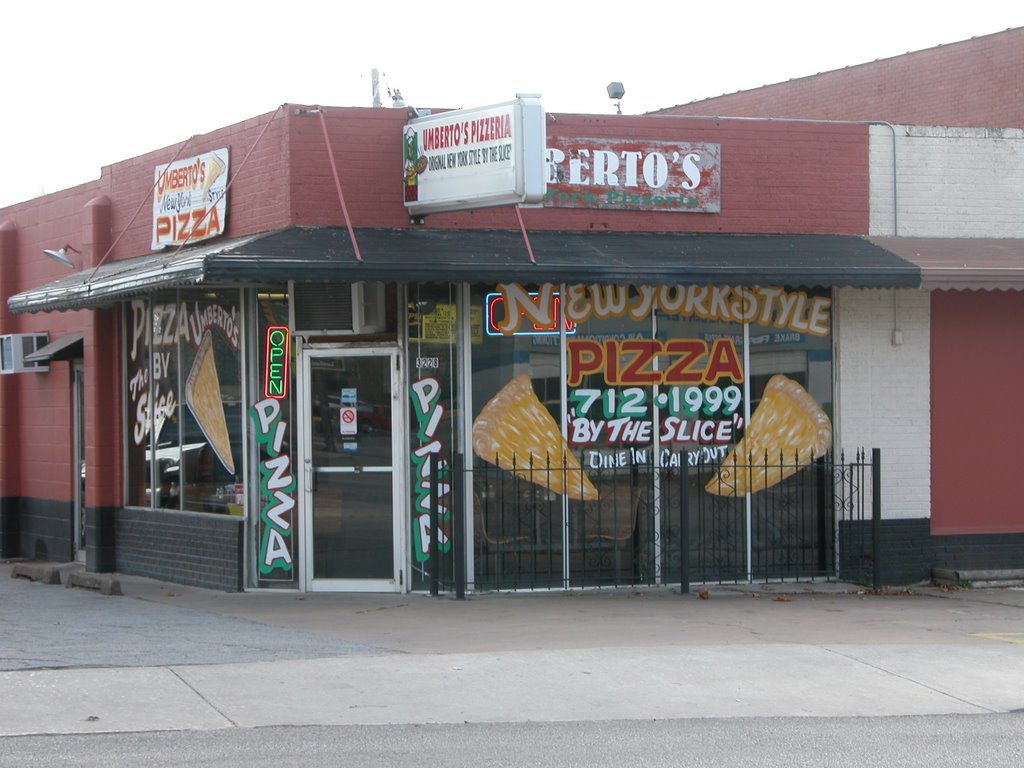
FINDING COMMUNITY AT UMBERTO'S PIZZA
I am not from Tulsa.
I need to say that because it conditions my response to this assignment. I am from St. Louis, where there are over 50 neighborhoods and I have a vague idea where about half of them are.
But drop me in T-Town and tell me to find a neighborhood, and I will stare at you wide-eyed and terrified. So when I found out I had to write about a local community, I went to a friend of mine who was raised here.
He told me to go to Umberto’s Pizzeria, on 21st Street just west of Harvard. He promised that I would find a full cast of interesting characters.
I initially found this statement to be flagrantly false. My friends and I were the only people in the restaurant.
So there I was, alone in a pizzeria and in serious need of some sort of community environment. After just a few minutes, though, it became obvious that there is a strong community in Umberto’s. But it isn’t in the restaurant proper—it’s in the large, open kitchen.
The workers of Umberto’s are a neighborhood unto themselves. While I was there, they were speaking Spanish to each other, their cheerful dialogue punctuated with bursts of uproarious laughter.
When Juan, the manager, tells me his favorite part of his job, he pitches his voice to be heard by the rest of the employees and says, “Telling them what to do.”
The other workers all laugh and call out flippant responses, and Juan laughs as though he had orchestrated the whole exchange. There’s something very familial in the way they all seem to know exactly what to say to get a rise out of the others, and the way they grin a little when they’ve finished saying something they know will get a laugh.
Umberto’s Pizzeria is not exactly what I was looking for when I set out to write this story. I was thinking more along the lines of a “where everybody knows your name” place.
But, really, a neighborhood feeling has nothing to do with how crowded a place is. It comes from the interactions of the people, the “cast of characters,” as my friend would say. And Umberto’s has characters that are truly worthy of applause.
--Laura Hermann
Friday, November 24, 2006

LIFE ON TULSA'S INDIANAPOLIS STREET
As I stepped out of my car and into a big pile of yellow and orange leaves, two kids greeted me.
“Would you like to buy some beef jerky, or a candy bar?” one of them asked.
I didn't.
After my visit with the kids, I began my walk down the long sidewalk. Indianapolis Street is located near Harvard and Eleventh Street. I picked this quiet neighborhood because it looked so diverse and interesting.
I drew in a deep breath of the crisp cold air; it smelled of fall leaves and acorns. The homes along Indianapolis Street are small and meticulous, some nicer than others.
One house in particular stood out to me. The house, which sits inside an iron fence, is a dark, algae-green color and decorated with numerous yard decorations. Two large trees and several bird feeders sit in the yard.
The four steps leading from the sidewalk onto the property guide you to patchy grass. The house has six big windows, in where I saw a gray cat sitting on the inside window ledge.
Directly across from the "algae" house is a white house with a burgundy cement porch. Four college boys live there. Luckily, one was stepping out of his car while I was around.
“How long have you lived in this house?” I asked him. The tall young man with curly blond hair replied, “About three months. We all moved in at the beginning of the semester.”
I asked him why they chose to live here. “It’s less that five minutes from campus which is nice, and this was one of the few four bedroom homes we could find,” he explained.
I thanked him and continued to walk down the street. As I came to the end of the sidewalk, I noticed a couple homes had decorative lights complimenting the trees and various aspects of the houses.
This end of the neighborhood was more chic and “homey.” The two kids I met earlier lived here. They were playing in the yard on their bicycles.
“We like our neighborhood because there’s lots of kids to play with,” the little girl said. She hopped back on her bicycle and peddled up to the other end of the neighborhood, the boy following closely behind.
--Lindsey Naylor
Wednesday, November 22, 2006
FIRST LUTHERAN SERVES MIDTOWN TULSA
The babble of children’s voices fills the parking lot play area of First Lutheran Church, 1244 South Utica Ave. It’s not Sunday, but ministry is a daily occurrence here.
Across the street, a sign in front of one building reads “Luther Place on Troost: A Senior Living Center with Assistance.” This refurbished apartment building is one of the many ministries of this church, located near Hillcrest Hospital.
Sharolyn is at the information desk as I enter. She had to “buzz” me in. Monitoring who comes and goes is all part of the service and the security associated with providing services for the very young and senior citizens.
“My job is to take messages, answer questions about various programs, monitor who comes and goes, and take Angel Food orders. I’m also in charge of Trinity Ministries. We have a Senior Nutrition Site here, a Senior Exercise Group, Senior Computer Classes, all kinds of programs,” Sharolyn said.
While I have been talking with her several other people have come and gone and the smell of lunch is in the air.
Melissa Shell is the First Lutheran Early Learning Center director. “The ELC has been in existence off and on for quite some time. One lady said her grandchildren came here 30 years ago,” she said.
“We’re currently a two-star facility and have four staff members who have their Child Development Associate certification and two more with Mastery certification. The rest are in school to obtain either an associate’s degree or their CDA,” Shell said.
“We’re here to serve our community, we service children who are blind, have kidney problems, and motor skill disabilities,” Shell said.
“Our classrooms build on each other. The infants get a lot of love and care. There’s a monthly curriculum for development that includes stories and songs, and by the time the children are in the Pre-K classes there are writing centers and they are learning colors and shapes,” she said.
The Early Learning Center is licensed to serve 52 infant through Pre-Kindergarten children and currently has 43 enrolled. The facility hopes to be fully accredited by next year.
Shell had to dash. She was headed to the store to buy milk for break time in the ELC.
First Lutheran also has programs that provide sack lunches for the homeless, a meeting place for Alcoholics Anonymous, and a meeting place for a Senior Deaf Group.
The ministry will hold a Jazz Festival Fundraiser on Thursday, Jan. 25, 2007.
--Karen Groff
The babble of children’s voices fills the parking lot play area of First Lutheran Church, 1244 South Utica Ave. It’s not Sunday, but ministry is a daily occurrence here.
Across the street, a sign in front of one building reads “Luther Place on Troost: A Senior Living Center with Assistance.” This refurbished apartment building is one of the many ministries of this church, located near Hillcrest Hospital.
Sharolyn is at the information desk as I enter. She had to “buzz” me in. Monitoring who comes and goes is all part of the service and the security associated with providing services for the very young and senior citizens.
“My job is to take messages, answer questions about various programs, monitor who comes and goes, and take Angel Food orders. I’m also in charge of Trinity Ministries. We have a Senior Nutrition Site here, a Senior Exercise Group, Senior Computer Classes, all kinds of programs,” Sharolyn said.
While I have been talking with her several other people have come and gone and the smell of lunch is in the air.
Melissa Shell is the First Lutheran Early Learning Center director. “The ELC has been in existence off and on for quite some time. One lady said her grandchildren came here 30 years ago,” she said.
“We’re currently a two-star facility and have four staff members who have their Child Development Associate certification and two more with Mastery certification. The rest are in school to obtain either an associate’s degree or their CDA,” Shell said.
“We’re here to serve our community, we service children who are blind, have kidney problems, and motor skill disabilities,” Shell said.
“Our classrooms build on each other. The infants get a lot of love and care. There’s a monthly curriculum for development that includes stories and songs, and by the time the children are in the Pre-K classes there are writing centers and they are learning colors and shapes,” she said.
The Early Learning Center is licensed to serve 52 infant through Pre-Kindergarten children and currently has 43 enrolled. The facility hopes to be fully accredited by next year.
Shell had to dash. She was headed to the store to buy milk for break time in the ELC.
First Lutheran also has programs that provide sack lunches for the homeless, a meeting place for Alcoholics Anonymous, and a meeting place for a Senior Deaf Group.
The ministry will hold a Jazz Festival Fundraiser on Thursday, Jan. 25, 2007.
--Karen Groff
Monday, November 20, 2006
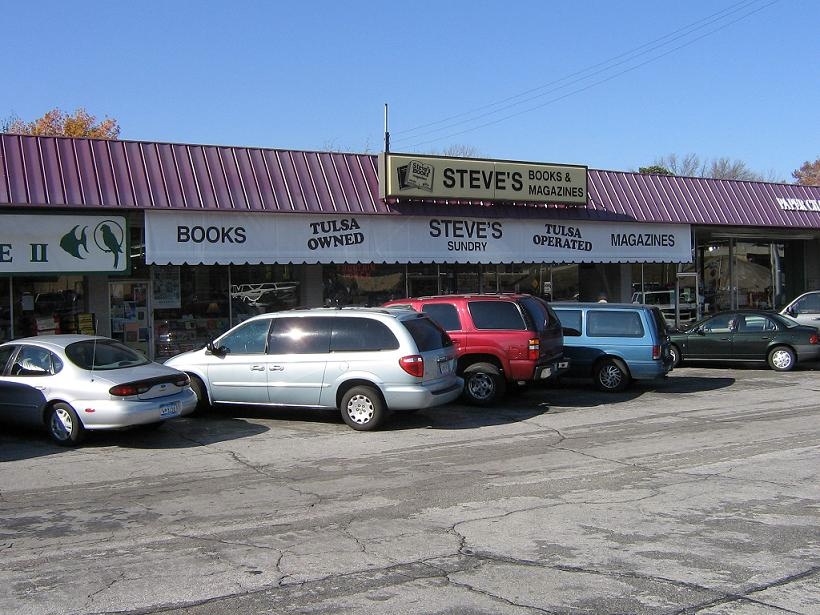
STEVE'S SUNDRIES: THE CHARMS OF THE NEIGHBORHOOD SHOP
Steve’s Books and Magazines—also known as Steve's Sundries—is nestled in the middle of a shopping center right where the Broken Arrow Expressway crosses over Harvard. It's the type of place that’s going out of style.
Corporate chains like Barnes & Noble—spacious, bright, and predictable—have taken a big place in our consumer consciousness. But there's a certain comforting charm in this little neighborhood shop that I’ve never found in a sterile chain store.
Under the same ownership for 59 years, Steve’s offers what seems like every magazine imaginable, along with paperbacks, candy, puzzles, posters, and other knickknacks. Cramped aisles are packed with goodies, the merchandise seeming to spill out, overwhelming the senses.
During my first visit, the air smelled heavily of dill pickles.
A soda fountain in the back, serving sandwiches, breakfast, sodas and shakes, attracts young and old alike, and allows for Steve’s catch phrase: “Whether you’re looking for shakes or Shakespeare, Steve’s is your place!”
I met the owner, Steve, by chance on my first trip, and he was more than eager to talk, shuffling to a corner to set down his cup of coffee and have a chat. He was quite proud of the fact that his store was the first of its kind to sell both books and magazines under the same roof.
Surprisingly, his relationship with bigger stores like Barnes & Noble is amicable, and he feels like more of a teacher than anything.
“I used to joke that we taught Barnes & Noble how to run a store,” he said with a chuckle.
Steve’s daughter-in-law, Joanie, currently owns half the store, and attributes its good business to regular customers.
“We have a very, very loyal clientele,” she remarked, telling me about the many women who come in daily to see what’s new. “It’s like Cheers without alcohol.”
Steve’s isn’t strong on designer atmosphere, but it has an old-fashioned feel that makes you feel good about supporting a local business. As long as they keep carrying The Onion, they can certainly count on my return.
--Caroline Richardson
Monday, November 13, 2006
CRIME AND PUNISHMENT IN OKLAHOMA
Burglary and larceny are two major kinds of crime in Oklahoma and the state's second largest city, Tulsa, has a higher crime rate on average than the state's largest city, Oklahoma City.
These are among the crime figures published by the information website areaconnect.com.
Statewide, 35,692 burglaries were reported in 2005, along with 93,814 larcenies. Oklahoma recorded 187 murders in 2005, down from 206 the previous year.
The most recent data comparing the crime rates of Tulsa and Oklahoma City were published in 2004 by disaster.com. The murder rate in Tulsa was 12.3 per 100,000 population, nearly double Oklahoma City's rate of 7.4 per 100,000. Aggravated assault was also significantly higher in Tulsa, 850 per 100,000 population compared to Oklahoma City's 521 per 100,000.
As of October 2006, Oklahoma prisons held almost 25,000 offenders, according to the Oklahoma Department of Corrections. The gender breakdown reported by the department this year was 89.7 percent male, 10.3 percent female.
The racial makeup of the prison population was 56.5 percent white, 28.8 percent African American, 8.6 percent Native American and 5.7 percent Hispanic. About 40 percent of those incarcerated were violent offenders, according to the Corrections Department.
Currently, the state has 86 prisoners on death row, including one female. As of mid-November this year, Oklahoma has put four prisoners to death by lethal injection, according to deathpenaltyinfo.org.
--Caroline Richardson
Burglary and larceny are two major kinds of crime in Oklahoma and the state's second largest city, Tulsa, has a higher crime rate on average than the state's largest city, Oklahoma City.
These are among the crime figures published by the information website areaconnect.com.
Statewide, 35,692 burglaries were reported in 2005, along with 93,814 larcenies. Oklahoma recorded 187 murders in 2005, down from 206 the previous year.
The most recent data comparing the crime rates of Tulsa and Oklahoma City were published in 2004 by disaster.com. The murder rate in Tulsa was 12.3 per 100,000 population, nearly double Oklahoma City's rate of 7.4 per 100,000. Aggravated assault was also significantly higher in Tulsa, 850 per 100,000 population compared to Oklahoma City's 521 per 100,000.
As of October 2006, Oklahoma prisons held almost 25,000 offenders, according to the Oklahoma Department of Corrections. The gender breakdown reported by the department this year was 89.7 percent male, 10.3 percent female.
The racial makeup of the prison population was 56.5 percent white, 28.8 percent African American, 8.6 percent Native American and 5.7 percent Hispanic. About 40 percent of those incarcerated were violent offenders, according to the Corrections Department.
Currently, the state has 86 prisoners on death row, including one female. As of mid-November this year, Oklahoma has put four prisoners to death by lethal injection, according to deathpenaltyinfo.org.
--Caroline Richardson
TOP CAUSES OF DEATH IN OKLAHOMA
Oklahoma has seen a significant rise in the number of heart disease related deaths in the past 10 years, according to statistics complied by the Centers for Disease Contol and Prevention.
The figures show that the mortality rate for heart disease varies significantly across the United States, with the highest rates in the southeastern states. Oklahoma's 1999 age-adjusted death rate was 317.4 deaths per 100,000 people, which was significantly higher than the overall U.S. rate of 268. This means that Oklahoma was ranked seventh among the states in heart disease deaths in 1999.
Other top causes of death in Oklahoma were (2) cancer (in the form of malignant tumors), (3) stoke, (4) respiratory diseases, and (5) accidental deaths. The top ten causes of death in Oklahoma also includes (6) influenza and pneumonia, (7) diabetes, (8) Azheimer's Disease, (9) suicide, and (10) atherosclerious.
Oklahoma spent $357.8 billion, or 31.5 percent of the state budget, on health care in 2003, accoring to the State Health Expenditure Report for 2000-2003.
--Brian Fagan
Oklahoma has seen a significant rise in the number of heart disease related deaths in the past 10 years, according to statistics complied by the Centers for Disease Contol and Prevention.
The figures show that the mortality rate for heart disease varies significantly across the United States, with the highest rates in the southeastern states. Oklahoma's 1999 age-adjusted death rate was 317.4 deaths per 100,000 people, which was significantly higher than the overall U.S. rate of 268. This means that Oklahoma was ranked seventh among the states in heart disease deaths in 1999.
Other top causes of death in Oklahoma were (2) cancer (in the form of malignant tumors), (3) stoke, (4) respiratory diseases, and (5) accidental deaths. The top ten causes of death in Oklahoma also includes (6) influenza and pneumonia, (7) diabetes, (8) Azheimer's Disease, (9) suicide, and (10) atherosclerious.
Oklahoma spent $357.8 billion, or 31.5 percent of the state budget, on health care in 2003, accoring to the State Health Expenditure Report for 2000-2003.
--Brian Fagan
Friday, November 10, 2006
IT'S ALL ABOUT THE MONEY: SOME OKLAHOMA INCOME FIGURES
At $45,000, Tulsa has the highest median salary of any city in Oklahoma, according to PayScale, a research website that tracks such numbers.
Oklahoma City ranks second on the PayScale list, with a median salary of $43,000.
Two Oklahoma college towns are third and fourth on the list, with Stillwater's median income at $40,000 and Norman's at $38,500.
Other Oklahoma cities on the list are Edmond and Lawton, both with a median income of $38,000, and Enid, which showed a median income of $32,280.
Missouri's two largest cities, St. Louis and Kansas City, exceeded Tulsa and Oklahoma City in median salary. Both St. Louis and Kansas City have median salaries ar $48,000.
Additional salary information can be found at the PayScale website, www.payscale.com.
--Lindsey Naylor
At $45,000, Tulsa has the highest median salary of any city in Oklahoma, according to PayScale, a research website that tracks such numbers.
Oklahoma City ranks second on the PayScale list, with a median salary of $43,000.
Two Oklahoma college towns are third and fourth on the list, with Stillwater's median income at $40,000 and Norman's at $38,500.
Other Oklahoma cities on the list are Edmond and Lawton, both with a median income of $38,000, and Enid, which showed a median income of $32,280.
Missouri's two largest cities, St. Louis and Kansas City, exceeded Tulsa and Oklahoma City in median salary. Both St. Louis and Kansas City have median salaries ar $48,000.
Additional salary information can be found at the PayScale website, www.payscale.com.
--Lindsey Naylor
Friday, November 03, 2006
MORE STREET STORIES ON THE WAY
The Street Stories experiment is continuing, and new stories will be posted in the coming weeks. Although the fall semester is rapidly winding down, the students have written a new batch of stories for the site.
The first group of new stories will be a bit different because I asked the class to develop stories based on numbers. Using on-line databases and other statistics, I wanted the students to profile Tulsa and Oklahoma numerically. My idea was to get the students more involved in descriptive quantitative data and to process and explain that data in interesting ways.
The students found the assignment harder than they (and I) expected—they were very clear on that point. Nevertheless, they found some curious figures that do tell us more about crime, income, education, industry, agriculture, health and other aspects of the city of Tulsa and the state of Oklahoma.
Look for these postings soon.
--John Coward, Faculty of Communication
The Street Stories experiment is continuing, and new stories will be posted in the coming weeks. Although the fall semester is rapidly winding down, the students have written a new batch of stories for the site.
The first group of new stories will be a bit different because I asked the class to develop stories based on numbers. Using on-line databases and other statistics, I wanted the students to profile Tulsa and Oklahoma numerically. My idea was to get the students more involved in descriptive quantitative data and to process and explain that data in interesting ways.
The students found the assignment harder than they (and I) expected—they were very clear on that point. Nevertheless, they found some curious figures that do tell us more about crime, income, education, industry, agriculture, health and other aspects of the city of Tulsa and the state of Oklahoma.
Look for these postings soon.
--John Coward, Faculty of Communication
Subscribe to:
Posts (Atom)